



Ghee in Ayurveda: Benefits, Uses, Properties & Types
Ghee has been part of Indian kitchens and Ayurvedic practice for thousands of years. In Ayurveda it is treated as both a food and a base for herbal preparations. This guide explains what ghee means in Ayurveda, how classical texts describe it, where modern evidence stands, and how to choose a good one.
What Is Ghee in Ayurveda?
In Ayurveda, ghee (called ghrita) is clarified butter made by slowly heating butter or cream-based butter until the water evaporates and the milk solids are removed. What remains is a golden, almost pure fat.
Ayurvedic texts place ghee among the most valued fats. They describe it as snigdha (unctuous), cooling, and nourishing to the body's tissues, or dhatus. It is also seen as a carrier that carries the qualities of herbs cooked into it.
Ghee in Ayurveda is also a practical ingredient. It is used for cooking and eating, applied on the skin, and prepared with herbs into medicated forms.
Importance of Ghee in Ayurveda
Ghee holds a special place because Ayurveda sees it as useful in almost every setting: daily food, seasonal diet, therapy, and external care.
Three ideas explain this:
- It is considered sattvic. Ayurveda classes it with foods that are pure, calming and easy for the mind to accept.
- It is a carrier. Ayurvedic texts describe ghee as taking on the properties of whatever is processed with it, a principle called samskara. This is why so many classical formulations are ghee-based.
- It is central to Panchakarma. Medicated ghee is used in snehana (oleation) therapy, which Ayurveda practises under a physician's supervision.
This is traditional Ayurvedic understanding, not a clinical finding. It explains why ghee became so central, but it should be read as tradition.
Properties of Ghee in Ayurveda
Ayurveda describes foods by their guna (qualities), rasa (taste), virya (potency) and vipaka (post-digestive effect). Ghee is generally described as:
- Rasa: sweet (madhura)
- Virya: cooling (sheeta)
- Guna: unctuous, soft, smooth
- Effect on doshas: balances Vata and Pitta, and in excess can increase Kapha
The cooling quality is what Ayurveda points to when it recommends ghee for heat-related imbalances. Its unctuous quality is why it is used where dryness is the concern, whether in the body or on the skin.
Modern analysis adds one useful reference point: ghee is almost entirely fat, mostly saturated, with small amounts of fat-soluble vitamins. That makes it energy-dense, which matters for how much you use.
Benefits of Ghee in Ayurveda
Classical texts credit ghee with many benefits. Modern research on ghee itself is more limited, so it helps to separate the two.
Ghee Benefits for Digestion
Ayurveda holds that ghee supports agni, the digestive fire, and eases dryness in the digestive tract. This is why a spoon of ghee is added to dal, khichdi and rotis in many homes. Modern studies on ghee's effect on digestion are limited, so treat this as a traditional view.
Ghee for Nourishment and Wellness
Ghee is traditionally seen as building ojas, the subtle essence linked with vitality and resilience. In practical terms, it is a calorie-rich food that makes meals more satisfying, and it helps the body absorb fat-soluble vitamins from food. These are the ayurvedic benefits of ghee most people experience in everyday cooking.
Ghee and Dosha Balance
Ghee is considered most helpful for Vata (dryness, irregularity) and Pitta (heat, sharpness). For Kapha types, Ayurveda advises smaller amounts, because ghee is heavy. It is also generally avoided when digestion feels sluggish or heavy.
Uses of Ghee in Ayurveda
Ghee as Food and Daily Nourishment
The most common use is the simplest: ghee on warm food. A small amount in cooked meals is how most families use it. Ayurveda also suggests ghee be used in measured quantity, according to digestion and constitution.
Ghee in Ayurvedic Formulations
Many classical preparations are built on ghee. Examples include Triphala Ghrita, Brahmi Ghrita and Phala Ghrita. In these, herbs are cooked into ghee according to a defined method. Such medicated ghee is meant to be prescribed and supervised by a qualified Ayurvedic practitioner, not self-prescribed.
Ghee as a Carrier for Ayurvedic Herbs
Many herbal compounds are fat-soluble, which means they dissolve in fat. That fits the traditional idea of ghee as a carrier, and it is a sensible reason why Ayurveda uses it as a base.
Types of Ghee in Ayurveda
Cow Ghee
Cow ghee is the form classical texts rank highest, and it is the one most Ayurvedic preparations use. Ayurveda describes buffalo and goat ghee too, each with different qualities, but cow ghee is the standard reference.
Desi Ghee
"Desi ghee" is a market term more than a classical Ayurvedic category. It usually means traditionally made ghee, often prepared by setting curd, churning it into butter (the bilona method), and heating that butter. If you see "desi" on a label, check what the product actually is.
Medicated Ayurvedic Ghee
These are ghee preparations cooked with herbs for a specific purpose, like the ghrita examples above. They are formulated and used differently from kitchen ghee. Ayurveda also classifies ghrita by age, such as purana and kumbha ghrita.
Cow Ghee Benefits in Ayurveda
Ayurveda considers cow ghee the best-suited ghee for most people. It is described as cooling, nourishing and balancing for Vata and Pitta. It is also the base for a large share of traditional ghrita formulations. For everyday eating, desi ghee benefits in Ayurveda depend largely on whether it is genuinely cow ghee made well, rather than on the word "desi" itself.
Ghee for Skin and Ayurvedic Skincare
Ayurveda uses ghee on the skin as well as in food. This section is about face care, with a brief note on the body. For ghee's wider skincare uses, there is a separate guide.
Benefits of Ghee for Skin
Ghee is an emollient, meaning it softens skin and helps hold moisture in. That is the reasonable, cosmetic way to describe what it does. Classical texts also mention ghee for wounds and burn-type conditions. Those are not claims to apply at home: if you have a burn or open wound, see a doctor rather than using ghee.
Ghee for Dry Skin
Dry skin is where ghee makes the most sense. Its unctuous quality suits skin that feels tight or rough. The catch is texture. Plain kitchen ghee is dense and greasy, and for oily or acne-prone skin it can feel heavy and may clog pores. If you want to try plain ghee, patch test first on a small area, and apply only a thin layer. For body dryness, such as elbows and heels, plain ghee is less of a concern than on the face.
Ghee-Based Ayurvedic Skincare
This is why Ayurveda developed washed ghee, covered next. It keeps ghee's traditional role while changing how it feels on the skin.
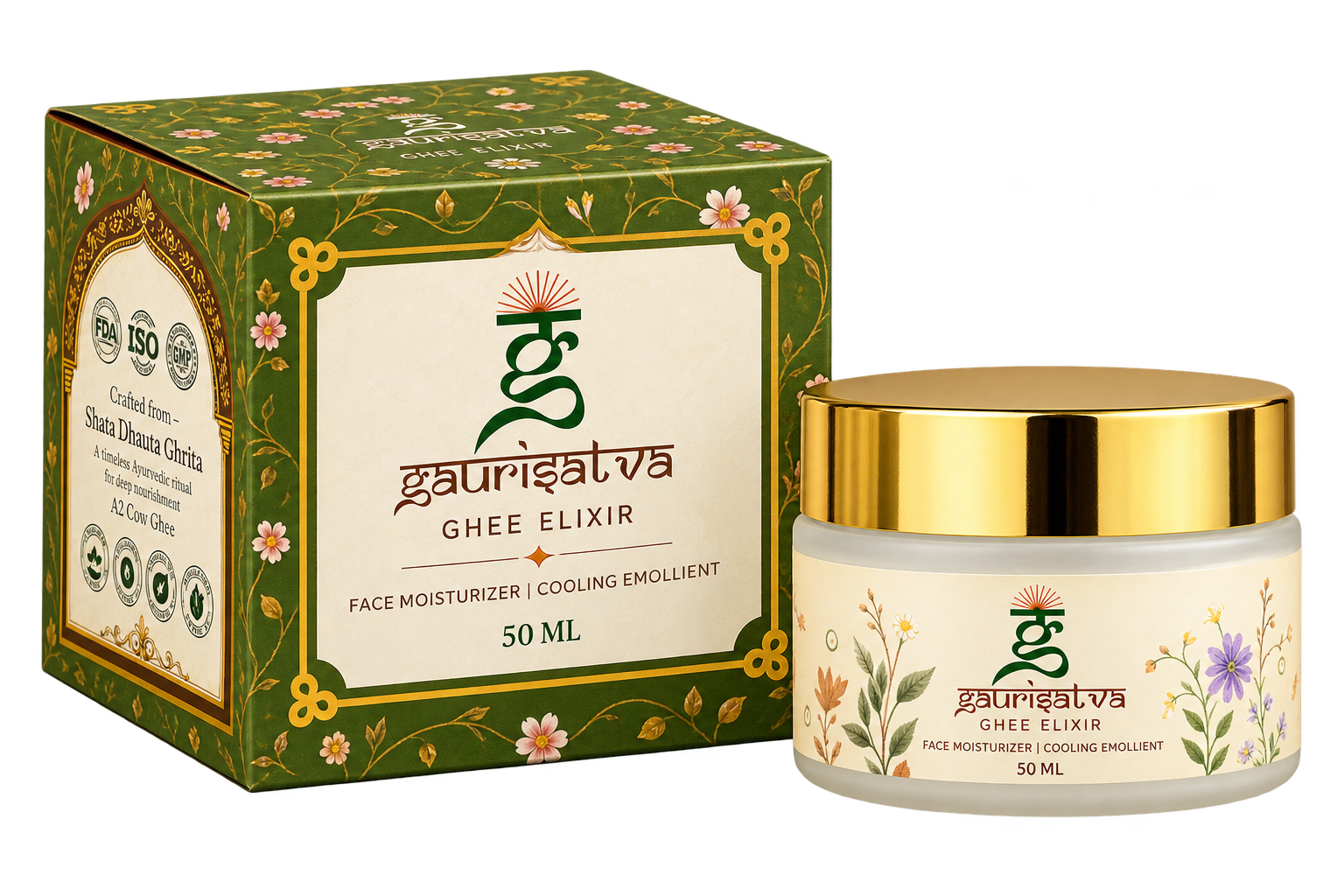
Gaurisatva's Cooling Emollient Cream is a ready-to-use version of this idea. It is made from 100 times washed A2 cow ghee, combined with Ashwagandha, Gotu Kola oil, Bakuchi oil and Arjuna bark extract. Use a pea-sized amount on clean skin, follow with sunscreen in the day, and patch test first if your skin is sensitive. It is for external use only.
How to Choose the Right Ghee
Ayurveda's traditional ghee is made with care, so a few checks help:
- Read the label. Look for a clear source (cow, buffalo), the method if stated (such as bilona), and an FSSAI licence number.
- Avoid trusting home tests. Tricks like the water or heat test are not reliable ways to judge purity.
- Match it to the use. Kitchen ghee is for eating. For skin, use a product made for skin, such as washed ghee.
- Mind the quantity. Ghee is calorie-dense. If you have high cholesterol, heart disease, fatty liver or weight concerns, check with your doctor before increasing it.
Frequently Asked Questions
How much ghee is okay to eat daily?
It depends on your diet, health and activity level. A small amount with meals is common in Indian homes, but there is no single right number. If you have a heart or cholesterol condition, follow your doctor's advice.
Is ghee suitable for Kapha types?
Ayurveda suggests Kapha types use less ghee, because it is heavy. Smaller amounts, especially with warming spices, are the usual traditional advice.
Can I use kitchen ghee on my face?
You can, but it is heavy for many skin types, especially oily or acne-prone skin. Patch test first and use a very thin layer. Washed ghee has a lighter texture.
Does ghee help with pigmentation?
There is no strong evidence that ghee fades pigmentation. Ayurveda combines it with herbs, but daily sunscreen matters far more for pigmentation. See a dermatologist for persistent patches.
Is washed ghee the same as regular ghee? They start from the same material, but 100 washes make it softer and lighter, which is why it is used on skin.
Disclaimer: This content is for informational purposes only and is not intended as medical advice. Always consult a qualified healthcare professional before starting any Ayurvedic treatment or remedy.
